RETB
Welcome to scot-rail.co.uk, Scotland's online railway community. The group is for any rail enthusiast interested in the railways and trains of Scotland. It not only consists of the wiki that you're reading now, but a busy online forum and mailing list, which was accessible to registered users. From April 2024 the forum has closed, with a replacement started on Groups.io.
Breadcrumb navigation
Introduction
Radio Electronic Token Block (RETB) is the signalling system in use on the West Highland Line, the Kyle Line and the Far North Line.Elsewhere, RETB was introduced on the East Suffolk line in 1985, and the Cambrian lines in 1988.
Similar in principle to Electric Token Block, RETB uses 'electronic' tokens issued to the driver by radio from a single control centre.
Items to be covered on this page (but not yet written):
- CDU
- Radio Channels
- Reflective Stop boards
- Token Exchange Points
- Hydro-pneumatic points
- Points set indicators
- Long-section tokens
- TPWS indicators
The Routes
North Highlands
- Ness Viaduct (Inverness) - Dingwall
- Dingwall - Kyle of Lochalsh
- Dingwall - Georgemas Junction
- Georgemas Junction - Wick
- Georgemas Junction - Thurso
These routes were initially controlled from Dingwall, and it was intended that the Inverness resignalling scheme would included the Inverness - Dingwall section. However RETB was extended to Inverness with control moved to the new Inverness Signalling Centre in August 1988 (Inverness RETB).
West Highland Lines
- Helensburgh Upper - Crianlarich
- Crianlarich - Oban
- Crianlarich - Fort William Junction
- Fort William Junction - Mallaig
- The 'South' work station controls Helensburgh Upper - Crianlarich - Oban
- The 'North' work station controls Upper Tyndrum - Fort William Junction - Mallaig
Sixteen signal boxes were closed under the resignalling scheme.
The Fort William area is controlled by conventional signalling from Fort William Junction signal box.
Fort Willliam Jn was renamed from Mallaig Junction to avoid any confusion when using RETB. Similarly, Tyndrum Upper was changed to Upper Tyndrum to distinguish it from Tyndrum Lower on the Oban line.
A list of Radio frequencies in use until 2016 on the West Highland Line can be found in the message archives.
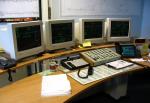 Inverness RETB workstation | 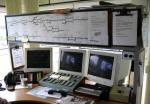 Banavie South workstation | 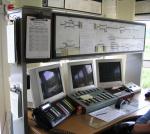 Banavie North workstation |
The Trains
In 1984 Inverness depot had a dedicated fleet of eight steam heat Class 37/0 locos fitted for RETB working on the Kyle line.By 1986 Inverness had four 37/0s and eight ETH class 37/4s covering both Kyle and Far North lines. This fleet remained constant until 1989 when Class 156 units were introduced.
From summer 1987 Eastfield's Class 37/4 fleet and 3 Class 20s were equipped with Radios and CDUs ready for the start of RETB operation.
In January 1989 a dedicated fleet of Class 156 units took over the daytime WHL passenger services and these were also with radios and CDUs.
From May 2000 Class 158s replaced 156s north of Inverness. The 158s had CDUs removed when working on other routes.
Class 66 and Class 67 locos have now largely replaced the class 37s, and EWS (now DB Cargo) and later GBRf created dedicated fleets permanently fitted with CDUs for working on RETB signalled routes.
Other operators such as WCRC fit their locomotives with CDU's on an as required basis.
Portable RETB equipment which combines a radio set and CDU in one case, is known as a Transportable Token Unit (TTU) and is now mostly used in Road/Rail vehicles for inspection and maintenance work.
Each train has a Cab Display Unit (CDU) with a unique 4-digit number.
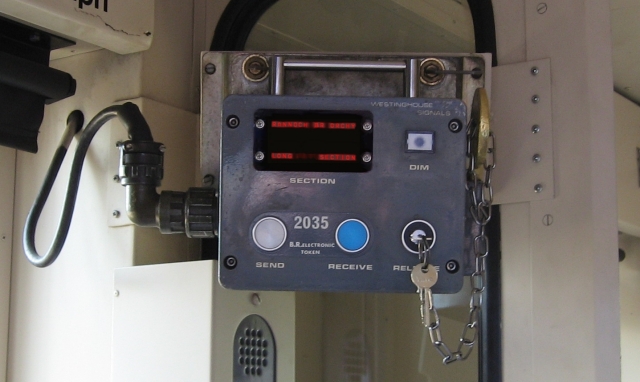 Cab Display Unit (CDU) in a Class 156 | 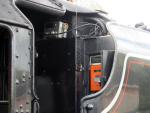 CDU in steam locomotive 45407 | |
Types of Electronic Token
- Section Token : Authorises movement from the stopboard (or section signal) at the entrance of the section to the stopboard (or signal) at the next Token Exchange Point. Tokens may have a suffix to remind the driver to arrive in a siding or 'wrong direction' platform. For attaching moves at Crianlarich and Georgemas, a 'Loop Occupied' suffix is used.
- Long Section Token: Authorises movement from the stopboard (or section signal) at the entrance of the section to a stopboard (or signal) ahead, without the need to stop at Intermediate Token Exchange Points (which have yellow sign below the stopboard). These locations which can be passed are noted on the Workstation sub pages as TEP-i.
- Shunt Token: Allows shunting movements to take place at at Token Exchange Point, within the Station Limits boards, and prevents other trains from approaching the TEP.
- Engineering Token: Allows track engineers to take possession of a Section between the Station Limits boards of two adjacent Token Exchange points.
- Test Token: Used for checking the Cab Display Units are working correctly.
Lineside Signage
Since Autumn 2003, RETB lines have also been fitted with TPWS. This has resulted in blue lights (Lineside Status Indicators) being fitted to Stop Boards to prove the TPWS system is functioning correctly.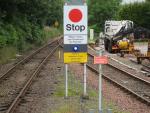 RETB stop board at Ardlui | 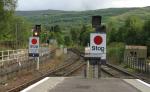 RETB stop boards at Crianlarich | 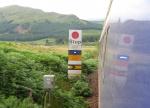 RETB stop board at Fillan |
Example signalling arrangement at a Crossing Loop
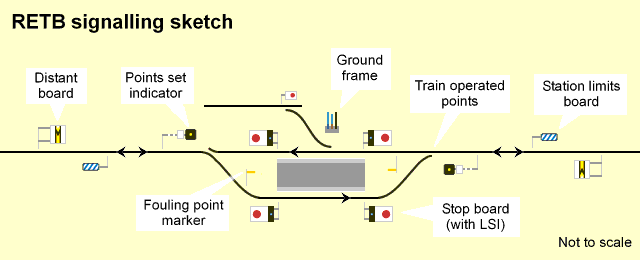
LSI = Lineside Status Indicator, for TPWS.
See also
Internal Links
- RETB Inverness Workstation (track and signalling)
- RETB Banavie South Workstation (track and signalling)
- RETB Banavie North Workstation (track and signalling)